
The weather in Mexico varies enormously from region to region, but the Riviera Maya enjoys a particularly pleasant tropical climate all year round.
Located on the Caribbean coast of Quintana Roo, the region attracts millions of travelers every year thanks to its warm temperatures, its beaches and its water activities, especially scuba diving.
In this guide, you’ll discover the different seasons in Mexico, the best times to visit the Riviera Maya and the ideal conditions for scuba diving.

The 2 seasons in the Riviera Maya
The Riviera Maya has a tropical climate, with temperatures between 79°F and 90°F (26°C and 32°C) all year round. Even in winter, the days stay warm and the Caribbean water keeps a pleasant temperature.
Between November and April, the weather is generally better. The days are sunny and rain is infrequent. This is the ideal time to travel to Mexico!


Between May and October, tropical rain shows up more often, but it doesn’t necessarily last all day. This is also the period with slightly fewer tourists.
July and August are still very popular despite the heat, because the water temperatures are especially pleasant.
Why the weather affects scuba diving
The weather can play a role in diving conditions in the Riviera Maya, but not necessarily in the way you might imagine!
During the rainy season, heavy rain can sometimes slightly reduce visibility, while the wind can cool the surface water a little. Even so, diving conditions generally remain excellent all year round.


Around Cozumel, visibility can reach 100 to 130 feet (30 to 40 m) in good conditions. The water temperature varies very little from season to season and is usually between 79°F and 84°F (26°C and 29°C).
Where the seasons have the most impact is on the marine species you can see underwater, and on the conditions in the cenotes.
Which species can you see in each season?
The marine biodiversity of the Riviera Maya changes throughout the year. Some species can be seen all the time, while others appear only during specific periods!
Bull sharks
In Playa del Carmen, you can see bull sharks between mid-November and mid-February. Conditions are especially favorable in December and January.

This is when the females migrate to the waters of the Riviera Maya to rest and give birth in areas close to the mangroves, although the exact locations are still unknown.
This seasonal migration makes sightings very frequent off Playa del Carmen and offers ideal conditions for divers who want to meet this iconic species.
Learn more about bull sharks!Whale sharks
In Isla Mujeres and off Cancún, you can see whale sharks between late May and mid-September. Conditions are especially favorable in June, July and August.
This is when whale sharks migrate to the plankton-rich waters of the Riviera Maya, drawn by the abundant food off the coast.

This seasonal migration makes encounters very frequent north of Cancún and offers ideal conditions for seeing these harmless giants in their natural environment.
It’s important to note that whale shark tours are snorkeling only.
The best times to explore the cenotes
Cenote diving is possible all year round in the Riviera Maya, thanks to a stable water temperature of around 75–79°F (24–26°C) and generally very consistent conditions.
However, the seasons have a strong influence on visibility, light, colors and the atmosphere of the dives, and some cenotes become especially impressive.
The effect of the sun in winter
In winter, the sun is lower in the sky. This creates more slanted light rays that reach deep into some caverns.
In cenotes like Chac Mool, this low-angle light produces very distinct beams and a darker, more contrasted atmosphere.


The visual effects become especially interesting for underwater photography and exploration-focused dives.
Winter is also when visibility is often at its best, thanks to the low rainfall.
The effect of the sun in summer
In summer, the sun is much higher and the light rays come down almost vertically into the open cenotes.
At sites like The Pit, this vertical light goes through the water all the way to the bottom and creates very spectacular columns of light.

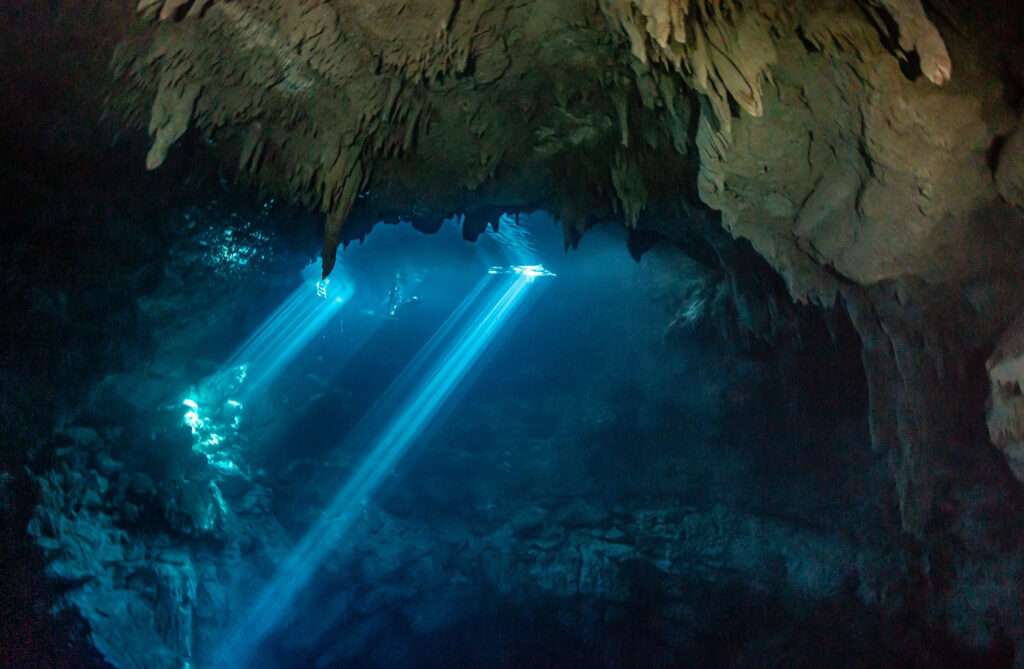
The effects are especially visible between late spring and midsummer, often around noon when the sun is at its highest.
Summer also brings different colors to some open cenotes. The heat and rain encourage tannins from decomposing leaves, which can create colored layers with yellow, green or orange reflections at the surface of the water.
When should you dive in the cenotes?Summary
Unlike other destinations, you generally don’t need to pack very different clothes depending on the season.
Whatever the time of year, it’s a good idea to bring light clothes, sunglasses and good sun protection. For boat days, a UV-protection shirt is also very useful to protect yourself from the sun.
The Riviera Maya offers excellent diving conditions all year round, both in the ocean and in the cenotes.
Each period, however, brings a different experience. Winter is ideal for exceptional visibility, seeing the bull sharks in Playa del Carmen and discovering unique light effects in some cenotes.
Summer, on the other hand, lets you see whale sharks off Cancún and Isla Mujeres, while enjoying spectacular light shows in cenotes like The Pit.
Book your dive with Triton Diving!