
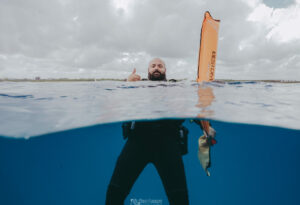
As everyone knows, you can’t talk underwater. So we communicate with simple, clear and universal signals.
It’s the basic language that keeps everyone safe, lets you understand each other quickly and avoids misunderstandings. The goal isn’t to learn 50 complicated gestures, but to master the ones that come up all the time.
Here are the 9 essential signals (plus a bonus) to know before any dive:

1) “OK”: the basis of everything
The most important signal is “OK”. You make a circle with your thumb and index finger, with the other fingers extended. This signal can mean two things:
- You ask: “Are you OK?”
- You answer: “Yes, I’m OK.”

Watch the demonstration of the signal here.
2) “Not OK / There’s a problem”
The other essential signal is the opposite of “OK”: “not OK”. You hold your hand flat and rock it slightly, like a “so-so”. It means: “I have a problem.” And it’s important that, right after, you show what the problem is.


You can point to your ear if you’re having trouble equalizing, to your regulator if something’s wrong, or to your BCD if you can’t manage your buoyancy.
The idea isn’t to make a drama of it. It’s to say clearly: “I need help” or “I need a break.” And that’s exactly what we want in diving: simple communication, with no pressure, no shame and no stress.
3) “Up”: thumbs up
In diving, thumbs up means one thing: we’re going up. Not “great”, not “well done”, not “awesome”. We’re going up.
It’s worth repeating, because it’s a classic mix-up for beginners, especially if you come from a culture where a thumbs up means “All good.”

Underwater, it’s different. If someone makes this signal, it means they want to end the dive or start the ascent, and we listen. Even if you feel great. Even if you want to stay. Safety comes first.
4) “Down”: thumbs down, we start the descent
You’ve probably guessed it… Thumbs down means: “we’re going down.” You’ll see it mostly at the start, when everyone gets ready for the descent, or if the guide suggests going back down a little to rejoin a group or a landmark.

Here too, it’s simple, clear and universal. And it’s a signal often used together with “OK”: descent, quick “OK?” check, then we carry on calmly.
5) “Stop”: we stop and regroup
An open hand, palm facing forward, means “stop”. It means: we stop. Not “wait two seconds while I take a look around”. No: stop. We stabilize, regroup and wait.

This signal is often used by guides who want to gather the group, check something, slow the pace or sort out a small issue.
6) “Look”: the signal you don’t want to miss
You point to your eyes with two fingers, then point to the object or direction: it means “look”, there’s a turtle, a ray or a shark in the distance, or a tiny detail hidden in the reef.

But be careful: “look” doesn’t mean “rush over”. It means “come and see calmly”. The best way to miss a magical moment is to rush in and fin like crazy.
Discover the marine life of the Riviera Maya!7) “Air”: check your pressure without waiting to run low
To ask about air, you tap gently on your regulator or your chest, then show your gauge. It means: “How much do you have left?” To answer, you show the pressure with your fingers, for example 100, 70 or 50, or the signal in the picture on the right, which means “I’m out of air”.


This signal is important because it’s part of a “clean” dive. A comfortable dive is one where you plan ahead. You don’t check your air only when you start to feel stressed.
We check regularly, especially at the start when everyone is finding their rhythm, and we adapt the plan to the group.
8) Turn around
An index finger making a circle, like a U-turn, means we’re turning around. You’ll often see this signal in a cenote when we reach the distance limit, or when air consumption means it’s time to head back.

And it’s a great signal, because it avoids the classic trap: going “just a little farther”, then coming back in a hurry.
In diving, we much prefer turning around early and finishing calmly over a stressful return. The fun is much greater when you know everything is under control.
9) Slowly / calm
A flat hand, palm down, moving gently up and down means: “slow down.” It’s used mostly on drift dives.

And often, it’s exactly what’s needed. Slowing down improves your buoyancy, lowers your air consumption and lets you see more. Animals don’t like haste. Neither does the reef. And you enjoy it much more.
Bonus: Shark
The most common signal for a shark is to place your flat hand on top of your head, like a small dorsal fin. Then you point in the direction where you saw it.
It simply means: “shark”.

The right reaction is to stay calm, maintain your buoyancy and follow the guide / stay with the group. That’s often when the encounter becomes the most beautiful: a calm pass, at a distance, without any commotion.
Discover bull shark divingThe little reminder that changes everything
If you remember only one thing: a signal must be seen, understood and confirmed. Make eye contact. Make the signal clearly. Wait for the answer.
Before each dive, take a moment to review the dive signals with your buddy. It avoids 90% of misunderstandings… and makes the dive much smoother.
And let’s be honest: the best moment is when someone gives you the “look” signal… and you discover something incredible. A turtle, a ray, a shark… or just a magical detail you’d never have seen on your own.
If you have a question before your try dive or your next dive, message us. We’ll explain everything.